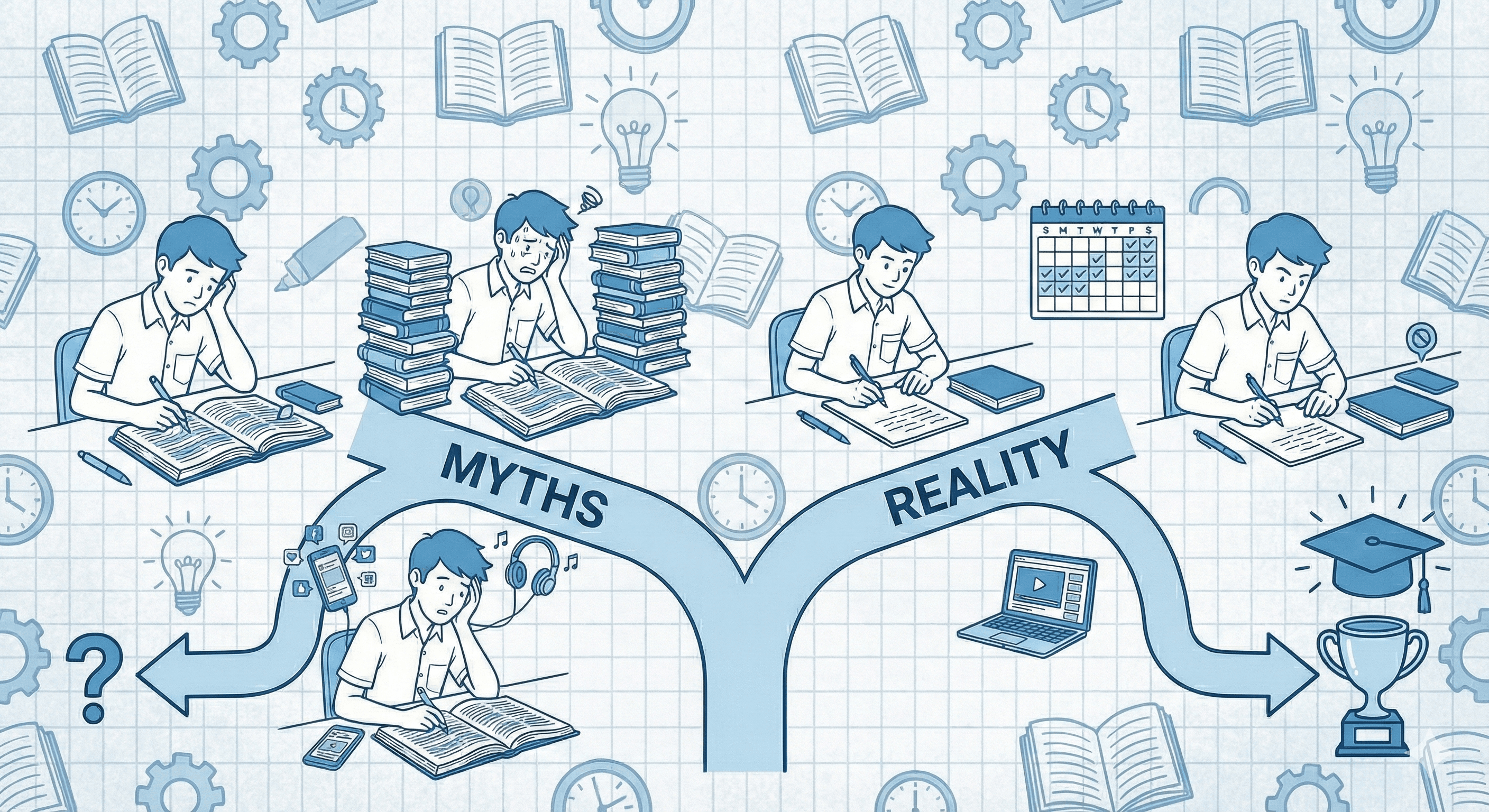
You’re putting in the hours. You have the textbooks. You have the highlighters. But are you actually studying effectively?
Many students fall into the trap of "pseudo-work"—activities that feel productive but don’t actually help your brain retain information under pressure. In this post, we are deconstructing the three biggest myths about exam preparation and replacing them with evidence-based strategies that actually yield results.
Let’s decode real exam success.
Myth 1: "Re-reading my highlighted notes is the best way to study."
The Reality:
This is perhaps the most common and damaging myth. Re-reading is a passive activity. It creates a "fluency illusion"—because you recognize the words on the page, you trick your brain into thinking you know the material. But recognizing something when it's right in front of you is very different from being able to recall it in a quiet exam hall without prompts.
The Fix:
You must struggle to learn. The harder your brain has to work to retrieve a piece of information, the stronger the memory link becomes.
- Stop endlessly re-reading chapters.
- Start closing the book and forcing yourself to write down or say aloud everything you remember about a topic. Only open the book to check what you missed.
Myth 2: "I should focus on one subject at a time and block-study it for days."
The Reality:
This is called "massed practice," and while it might help you pass a test tomorrow, it's terrible for long-term retention. Your brain gets bored doing the same thing for hours. It starts to tune out, and the information doesn't get embedded deeply. You might feel like you've mastered a topic after six hours of math, but you'll likely forget most of it by next week.
The Fix:
Your brain is like a muscle that needs rest days to grow.
- Spaced Repetition: Instead of studying a topic for 5 hours once, study it for 1 hour a day over 5 days. This forces your brain to constantly reload the information from long-term memory, strengthening the neural pathways.
- Interleaving: Don't just study Math all day. Mix it up. Do an hour of Math, then an hour of History, then an hour of Science. This forces your brain to constantly switch gears and identify the right strategy for different types of problems, which leads to deeper learning.
Myth 3: "I can multitask and study while listening to music with lyrics or checking my phone."
The Reality:
True multitasking is a myth. Your brain cannot focus on two complex cognitive tasks at once. It's actually "task-switching"—rapidly jumping between studying and listening to lyrics or checking a notification. Every time your brain switches, there's a "cognitive cost." You lose focus, make more mistakes, and it takes you longer to get back into the "flow" of studying. What feels like productive multitasking is actually just a series of micro-distractions that destroy your efficiency.
The Fix:
To learn difficult concepts, you need periods of intense, unbroken concentration.
- Eliminate Distractions: Put your phone in another room. Use website blockers on your computer. Create a quiet study zone.
- Focus on One Task: Set a timer for 25-50 minutes (like the Pomodoro technique) and commit to doing only one thing—studying. No phone, no emails, no social media. You'll be amazed at how much more you get done in less time.
Highlights & Notes
Select any sentence in the article and save it to your library with a private note.
Local highlights are available now. Sign in to sync your highlights across devices.
No highlights yet for this article.
Was this helpful?
Your feedback shapes what we publish next.
Ask This Article
Need help on this topic?
Human-moderated support from the editorial team.