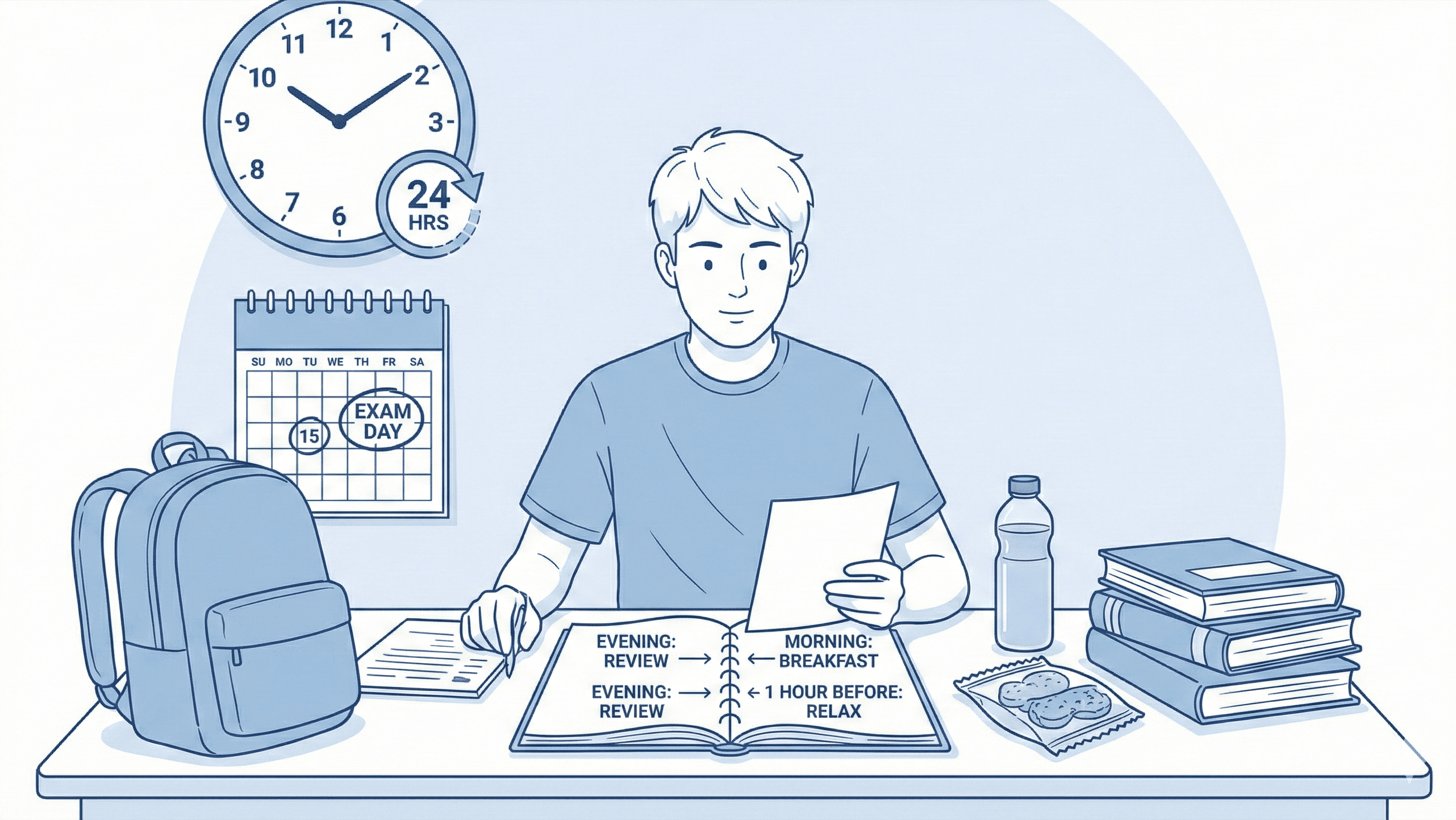
Success in exams isn't just about what you know; it's about how you manage your physical and mental state in the final 24 hours.
Here is your hour-by-hour guide to navigating the critical time window before the bell rings.
Phase 1: The Evening Before (Preparation)
Timeline
6:00 PM
The Final "Light" Review
Stop trying to learn new topics. If you don't know it by now, cramming will only confuse what you do know. Instead, lightly review your summary sheets, flashcards, or formulas. Keep it low-stress.
8:00 PM
The "Kit Check" (Crucial Step)
Panic often sets in on exam morning because something is missing. Eliminate this risk the night before.
- Stationery: Do you have two working pens? A sharp pencil? An eraser?
- Documents: Is your Admit Card/Hall Ticket in the bag?
- Uniform: Is it ironed and ready?
Phase 2: Exam Morning (Fuel & Focus)
Timeline
7:00 AM
The Power Breakfast
Do not skip this meal. Your brain runs on glucose. A sugary cereal will give you a crash halfway through the exam. Instead, opt for slow-release energy like oats, eggs, or whole-wheat toast.
8:00 AM
The "Panic-Free" Zone
You might feel the urge to frantically flip through your textbook one last time. Resist it. This only increases anxiety. If you must do something, review your one-page summary sheet of key formulas or dates. Keep it light and brief.
Phase 3: The Exam Hall (Strategy & Execution)
Timeline
9:00 AM
The "Social Distancing" Rule
When you arrive at school, you will see huddles of students frantically quizzing each other. Stay away. Hearing someone ask, "Did you study the subplot on page 84?" will trigger immediate self-doubt, even if you are well-prepared. Put on headphones, listen to calming music, and stay in your own zone until you enter the hall.
9:30 AM
The First 15 Minutes (The Scouting Phase)
Most boards give you 15 minutes of reading time. Don't waste this staring at the ceiling. Rank the Questions: Mark the questions you know 100% with a small tick. These are your "confidence boosters." Do them first. Spot the Traps: Look for keywords like "Explain briefly" vs "Describe in detail" or "Not." Plan the Hard Stuff: For the toughest question, scribble a few keywords in the margin immediately so you don't forget your initial thoughts later.
The "Brain Freeze" Protocol:
If you look at a question and your mind goes blank, do not panic. It’s a temporary cortisol spike.
- Close your eyes.
- Take a deep breath in for 4 seconds, hold for 4, exhale for 4.
- Skip the question. Solving an easier one will unlock your memory for the harder one later.
Phase 4: Post-Exam (The "Dump and Move On")
Timeline
12:30 PM
The Ban on Post-Mortems
The moment you step out of the hall, someone will scream, "The answer was 42, right?!" Walk away. Discussing the paper you just finished has zero benefit. It cannot change your grade, but it can ruin your confidence for the next exam. Treat the paper as "files deleted" and immediately shift your focus to rest and the next subject.
Highlights & Notes
Select any sentence in the article and save it to your library with a private note.
Local highlights are available now. Sign in to sync your highlights across devices.
No highlights yet for this article.
Topics
Was this helpful?
Your feedback shapes what we publish next.
Ask This Article
Need help on this topic?
Human-moderated support from the editorial team.