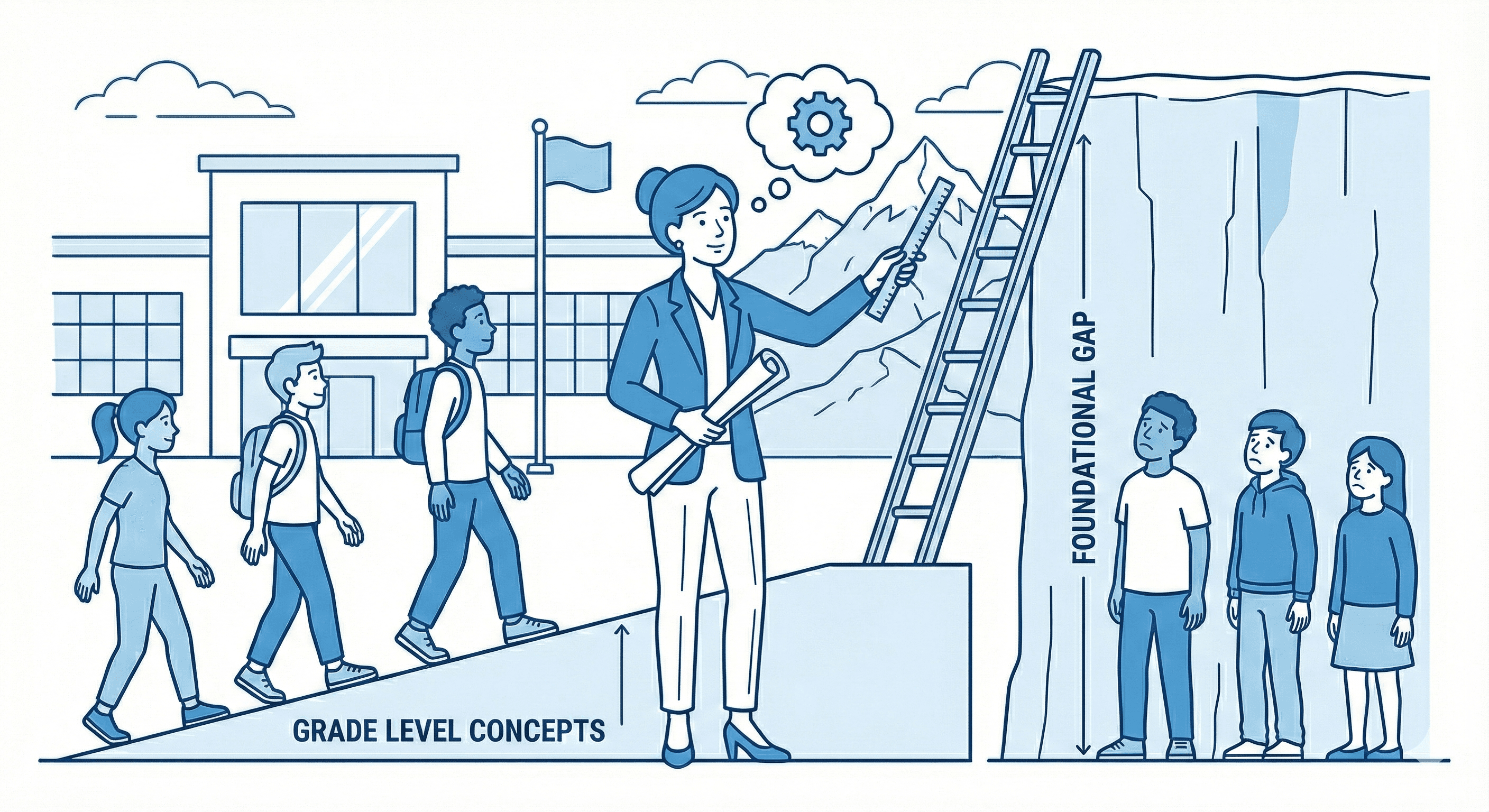
Today, we need to discuss the terrain we are sprinting on. It’s rarely flat.
In an ideal world, every student entering Class 7 has mastered Class 6 concepts. In reality, especially in the post-pandemic landscape of Indian education, a typical Class 7 classroom contains a massive chasm in varied abilities.
You might be teaching a chapter on "Rational Numbers." Five students in the front row are bored because they already get it. Ten students in the middle are following along okay. But twenty students in the back are staring blankly because they never truly mastered basic fractions in Class 5.
The emotional toll on a teacher in this situation is immense. You feel like you are constantly failing someone. If you slow down for the back row, you hold back the front row. If you speed up, you lose half the class.
How do you bridge this chasm without working 24 hours a day creating individual lesson plans? We need to shift from "teaching to the middle" to "teaching to the edges."
The Scenario: The "One-Size-Fits-All" Failure
Imagine you are a shoe salesperson, and you decide to only stock size 8 shoes because that’s the average size. Customers with size 6 feet will be swimming in them; customers with size 10 feet won't even get them on.
When we deliver one standard lecture and give one standard homework assignment to a mixed-ability Class 8 room, we are only stocking size 8 shoes.
The Toolkit: Realistic Differentiation Strategies
We know you are overworked. Here are three high-impact strategies that don't require hours of extra prep time.
1. The "Tiered Exit Ticket" (Quick Check)
Instead of giving the same 5-question homework to everyone, spend the last 10 minutes of class giving a "Tiered Exit Ticket."
- Level A (The Basics): 3 questions testing the absolute prerequisite knowledge needed for today's lesson. (e.g., simple LCM calculation).
- Level B (Grade Level): 2 questions based on what you taught today.
- How it works: Students must finish A before attempting B. You collect them at the door. A quick glance tells you exactly who is struggling with the foundation vs. the new concept. You don't grade these; you use them to group students tomorrow.
2. The "Peer Pod" System (Jigsaw Method)
Stop trying to be the only source of knowledge in the room.
- The Strategy: Group students into pods of four—one advanced, two average, one struggling. Give the group a complex problem. The rule is: "The group doesn't finish until everyone in the group can explain the answer."
- Why it works: The advanced student solidifies their knowledge by teaching (the highest form of learning). The struggling student often understands a peer's explanation better than a teacher's formal language. You shift from lecturer to facilitator, circulating and helping the pods that are stuck.
3. "Low Floor, High Ceiling" Tasks
Design activities where everyone can start, but the complexity can go high.
- Example (English Class 7): Instead of saying "Write an essay on climate change," say "Choose an image related to climate change. Write about it."
- Differentiation: The struggling student might write three simple descriptive sentences (Low Floor). The advanced student might write a persuasive paragraph using complex vocabulary (High Ceiling). Both are engaged with the same topic at their own level.
Final Thought
Closing the chasm in middle school isn't about miraculously getting everyone to the same level by March. It's about ensuring every student, regardless of where they started, makes one year's worth of progress in one year.
Are you teaching to the edges?
Highlights & Notes
Select any sentence in the article and save it to your library with a private note.
Local highlights are available now. Sign in to sync your highlights across devices.
No highlights yet for this article.
Was this helpful?
Your feedback shapes what we publish next.
Ask This Article
Need help on this topic?
Human-moderated support from the editorial team.