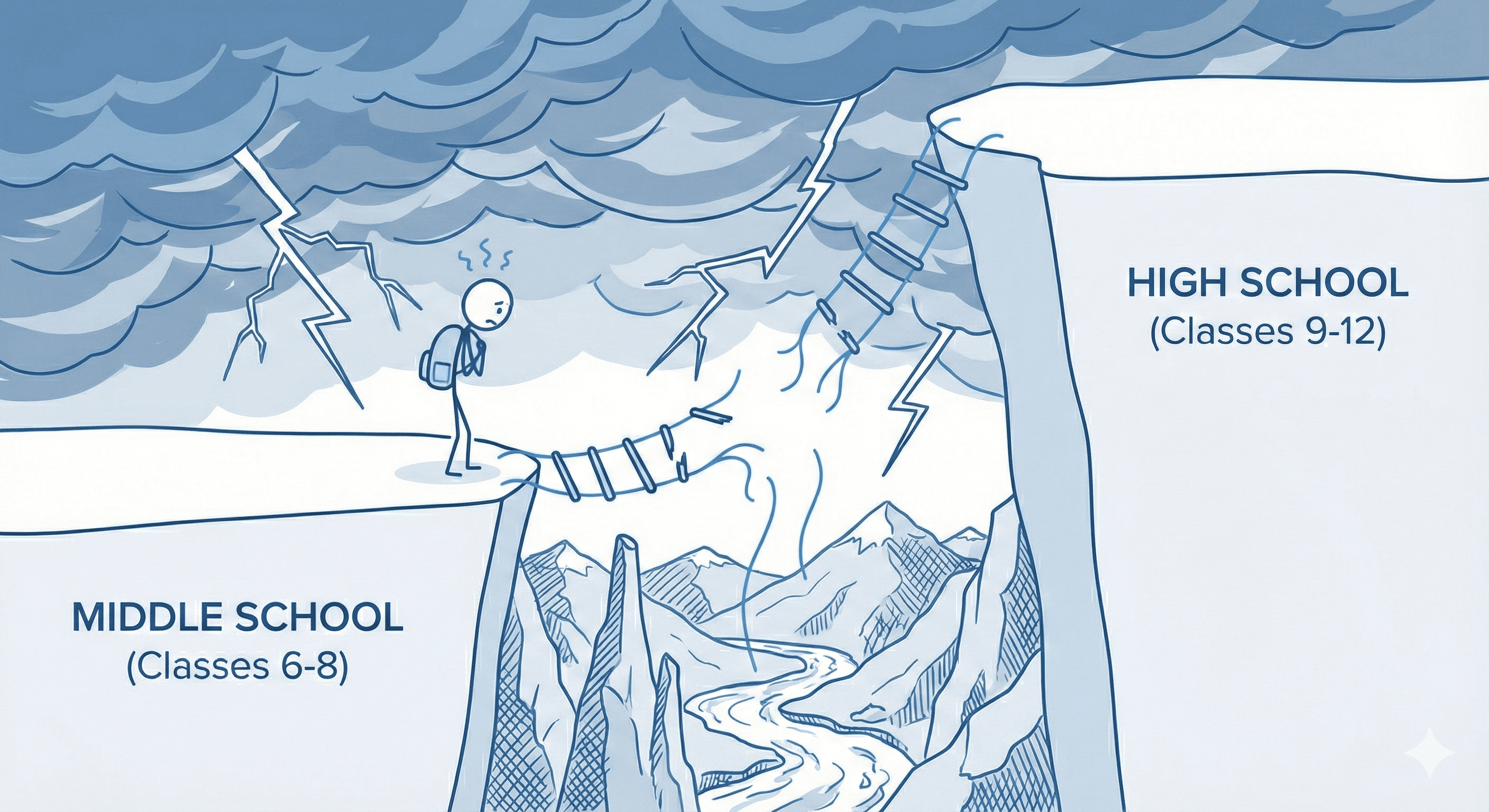
In our previous post, we talked about the "cracks in the foundation." Today, we need to talk about the moment those cracks usually cause the building to shake: The entry into Class 9.
In the Indian education context, the transition from Class 8 to Class 9 is rarely a smooth uphill path. It is more often a steep cliff. Parents are often bewildered when their child, who consistently scored 90% in Class 8, suddenly brings home a marksheet with 60% in the first unit tests of Class 9.
Is the child suddenly studying less? Usually not. The problem is that the game has changed, but the player is still using the old rules.
If Middle School (6-8) is about learning the alphabet of a subject, High School (9-10) is about writing complex essays with that alphabet. If you don't know the letters perfectly, you cannot write the essay.
Here are the three major "Shifts" that catch students off guard during this transition, and why Studymaxx’s focus on the 6-8 range is critical for long-term success.
Shift 1: The "Volume" Shift (Quantity)
The most immediate shock is the sheer bulk of the books.
In Class 8 Science, you might have a chapter on "Force and Pressure" that is 10 pages long with 5 main definitions to remember. In Class 9 Physics, that same concept explodes into multiple chapters covering Newton's Laws of Motion, Gravitation, and Work & Energy, requiring dozens of formulas and complex numericals.
- The Middle School Mistake: Students are used to studying a chapter two days before a test and managing well.
- The High School Reality: If you don't study consistently every day, the backlog becomes insurmountable within a month. You need the stamina developed in Classes 6-8 to handle this volume.
Shift 2: The "Abstraction" Shift (Complexity)
Up until Class 8, many concepts are concrete—things you can see or easily imagine. Suddenly, Class 9 introduces highly abstract concepts. In Chemistry, you aren't just mixing baking soda and vinegar anymore; you are visualizing electron configurations and mole concepts—things you cannot see with the naked eye. In Math, geometry moves from measuring angles to abstract theorems and proofs.
- The Middle School Mistake: Relying on "pattern matching" to solve problems (e.g., "If I see this type of question, I use these steps") without understanding why the steps work.
- The High School Reality: Questions are twisted. Pattern matching fails. Only deep conceptual understanding survives.
Shift 3: The "Application" Shift (Testing Style)
This is where the modern Indian education system (driven by NEP reforms) is heading.
A Class 7 question might ask: "Define Photosynthesis." A Class 9 or 10 question will ask: "A plant was kept in a dark room for 72 hours. What experiment would you conduct to prove that sunlight is essential for photosynthesis? Explain the chemical changes expected."
The new style of testing doesn't care if you know the definition. It demands that you can use the definition to solve a new problem.
Building the Bridge with Studymaxx
If you are currently in Class 6, 7, or 8, do not view these years as a "waiting room" for high school. These are the years you build the bridge across the chasm.
If you arrive at Class 9 with weak arithmetic, shaky grammar, or a poor understanding of basic scientific vocabulary, you will spend all your energy just trying to catch up, rather than moving forward.
The "Pre-Flight" Checklist (Mathematics)
The "Pre-Flight" Checklist (Science)
At Studymaxx, our materials for Classes 6-8 are designed with this eventual jump in mind. We don't just cover the current syllabus; we ensure the concepts that will be vital for Class 9 are reinforced exponentially. We prioritize the "why" over the "what," ensuring that when the student reaches that chasm, they have a solid bridge to walk across, not a shaky rope ladder.
Highlights & Notes
Select any sentence in the article and save it to your library with a private note.
Local highlights are available now. Sign in to sync your highlights across devices.
No highlights yet for this article.
Topics
Was this helpful?
Your feedback shapes what we publish next.
Ask This Article
Need help on this topic?
Human-moderated support from the editorial team.