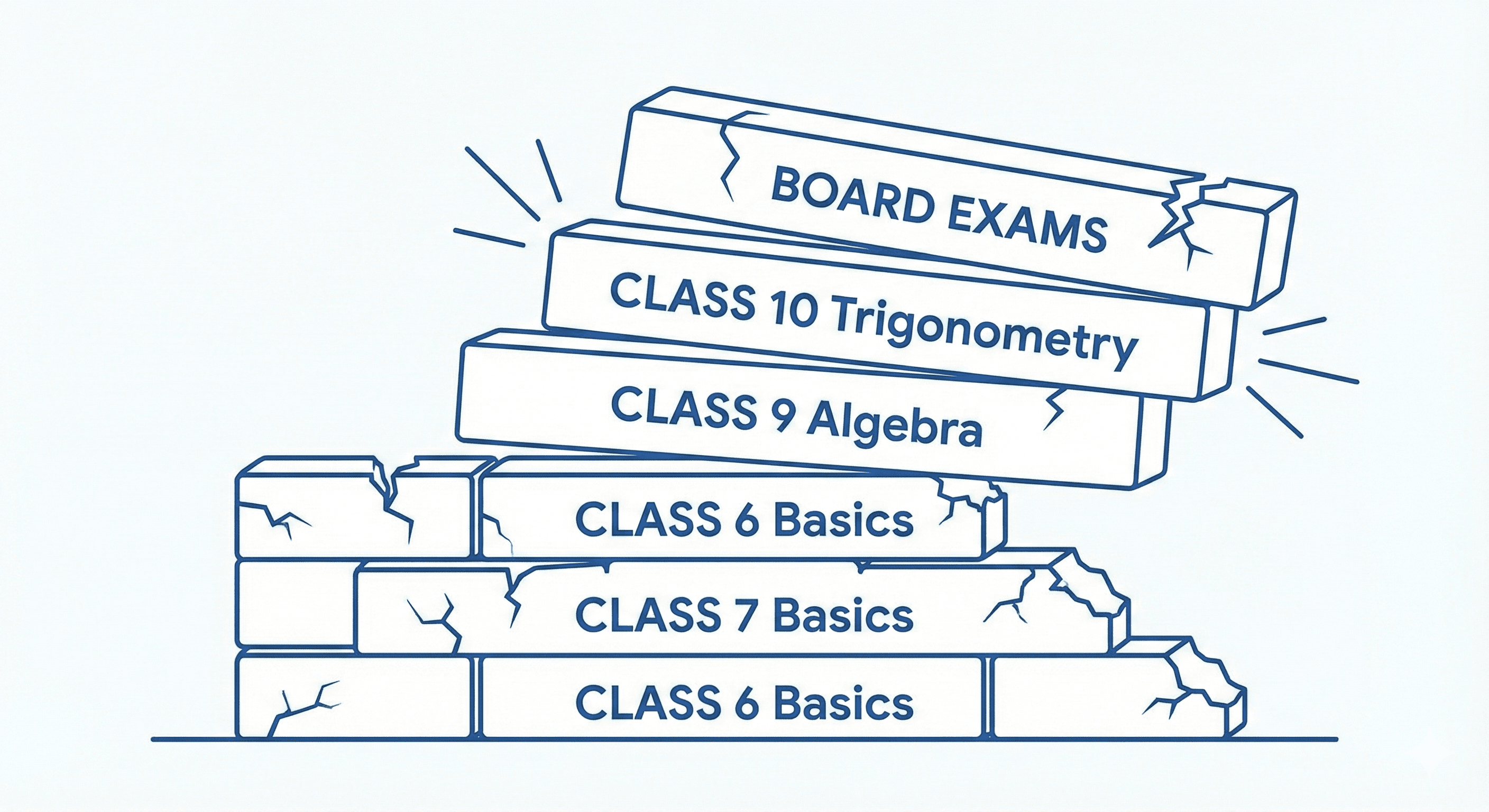
In the landscape of Indian education, there is a massive spotlight on Class 10 and 12 Board Exams. The pressure cookers of coaching centers and intense parental expectations usually kick into high gear around Class 9.
But there is a silent crisis happening before that. It happens in the often-overlooked "middle years"—Classes 6, 7, and 8.
Many students coast through these years. The syllabus expands, but it doesn't seem immediately threatening. Students—and sometimes parents—adopt a "we'll get serious in Class 9" attitude. This is perhaps the single biggest mistake in a student's academic journey.
At Studymaxx, focusing on books for Classes 6-8, we see this pattern constantly. The struggle a student faces in Class 10 rarely starts in Class 10. It started in Class 7 when they memorized a formula instead of understanding why it works.
The Brick Wall Theory
Imagine your education as building a brick wall.
Primary school (Classes 1-5) involves laying the ground. You learn numbers, basic sentences, and observation.
Middle School (Classes 6-8) is where you build the crucial lower layers of the wall. You transition from arithmetic (2 + 2 = 4) to algebra (2x + y = ?). You move from reading stories to analyzing grammar structures.
If you rush through these layers, leaving cracks in the bricks or missing mortar—by rote memorizing just to pass a unit test—the wall looks fine for a while.
Then comes High School (Classes 9-12). You try to place heavy, complex concepts like Trigonometry, Calculus, and Organic Chemistry on top. Suddenly, the wall starts to wobble. The student panics. They work harder, study longer hours, but they can't grasp the new topics.
Why? Because the foundation is cracked. You cannot build a penthouse on a shaky basement.
The "Cumulative Deficit" in Indian Schools
Indian curriculums (CBSE, ICSE, and State Boards) are cumulative. They assume you have mastered the previous year's content completely. If a student misses the core concept of "fractions" in Class 6, they will struggle with "rational numbers" in Class 8. By the time they reach "algebraic expressions involving fractions" in Class 9, the math looks like an alien language.
It’s not that the student isn’t smart; it’s that they are trying to solve an advanced puzzle with missing starter pieces.
Here is how basic concepts in middle school translate to high school hurdles:
| Subject | The Class 6-8 Foundation (The "Easy" Stuff) | The High School Consequence (If foundation is weak) |
|---|---|---|
| Mathematics | Understanding Integers, Fractions, and basic BODMAS rules. | Inability to solve complex Algebraic equations or Calculus because basic signs (+/-) get confused. |
| Science | Basic cell structure, atoms vs. molecules, laws of motion examples. | Struggling with Genetics, organic chemistry reactions, or deriving physics formulas in Class 11. |
| English | Parts of speech (nouns, verbs, adjectives), basic sentence structure, tenses. | Poor essay writing skills, inability to comprehend complex literature, losing marks in competitive English sections. |
| Social Studies | Basic understanding of maps, latitude/longitude, timelines of history. | Difficulty grasping geopolitics, economics graphs, or connecting historical cause-and-effect for long answers. |
The Shift Away from Rote Learning
For decades, many students survived middle school by mugging up definitions the night before the exam.
However, the educational landscape is changing, especially with the National Education Policy (NEP) emphasizing competency-based learning. The focus is shifting from "what you remember" to "how you apply what you know."
Modern question papers are increasingly testing conceptual clarity. If your child is used to memorizing answers in Class 7 without understanding the underlying concept, they will hit a massive roadblock when faced with the analytical questions of Class 10 Boards and competitive exams like JEE or NEET later on.
How to Fix the Cracks Now (With Studymaxx)
The good news is that the middle school years are flexible. There is still time to reinforce the wall before the heavy loads of high school arrive.
- Stop Ignoring "Silly Mistakes": If a Class 8 student makes calculation errors frequently, don't dismiss it. It usually indicates a gap in Class 6 arithmetic rules. Go back and fix it.
- Prioritize Conceptual Clarity over Marks: In Classes 6-8, getting 95% by memorizing is useless. Getting 80% while fully understanding every concept is a victory.
- Use Targeted Resources: This is where Studymaxx comes in. Our books specifically for Classes 6, 7, and 8 are engineered not just to help cover the syllabus, but to ensure the foundations are rock solid. We focus on the "why," ensuring the bricks laid today can support the weight of tomorrow's challenges.
Don't wait until the wall is wobbling. Strengthen the foundation today.
Highlights & Notes
Select any sentence in the article and save it to your library with a private note.
Local highlights are available now. Sign in to sync your highlights across devices.
No highlights yet for this article.
Topics
Was this helpful?
Your feedback shapes what we publish next.
Ask This Article
Need help on this topic?
Human-moderated support from the editorial team.