We hear this constantly from parents of Class 7 and 8 students: "My child studies for three hours every evening, but their marks aren't improving. I don't know what's wrong."
The problem usually isn't lack of effort; it's the method of effort.
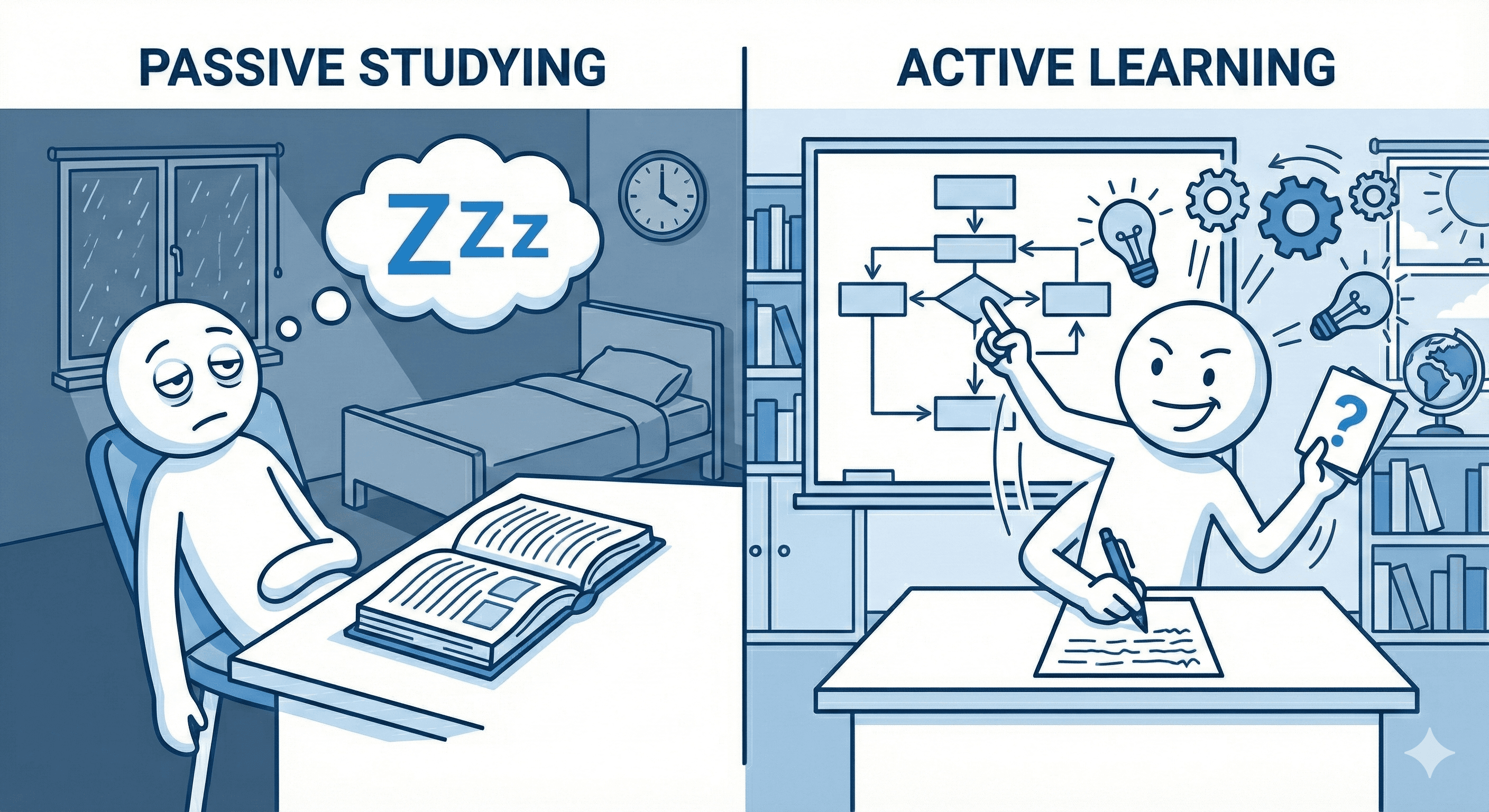
For generations, "studying" in many Indian schools meant opening a textbook, highlighting lines, and re-reading them until they stuck in memory. This is passive learning. It's like trying to learn how to play cricket by just watching matches on TV. You might know the rules, but you won't be able to hit a ball.
Middle school is crucial because it's when the brain's capacity for abstract thinking grows. You must shift from being a "content consumer" to a "knowledge creator."
Here is how to flip the switch from passive to active learning across core subjects.
The New Toolkit: Active Strategies for Every Subject
Instead of just "reading the chapter," try these specific, output-based techniques.
1. For Science: The "Blank Sheet" Method
- The Old (Passive) Way: Reading the chapter on "Acids, Bases, and Salts" three times and highlighting definitions.
- The New (Active) Way: After reading a section once, close the book. Take a blank sheet of paper. Now, try to draw a flowchart or a diagram explaining the concept of neutralization, using only your memory. If you get stuck, that's the exact gap in your knowledge. Open the book, fix that specific gap, and try again.
2. For Social Studies (History/Civics): The "Reporter" Technique
- The Old (Passive) Way: Memorizing a list of dates and battles for the Mughal Empire.
- The New (Active) Way: Imagine you are a news reporter traveling back in time. Don't just list dates. Write a short news script explaining why a battle happened and what changed because of it. Turn isolated facts into a connected narrative. Our brains remember stories far better than lists.
3. For Mathematics: The "No-Hint" Rule
- The Old (Passive) Way: Looking at a solved example in the textbook, nodding your head, and saying, "Okay, I get it."
- The New (Active) Way: Never look at a solution until you have tried to solve the problem yourself for at least 10 minutes. Struggling with the problem is where the learning happens. If you just read the solution, you have robbed yourself of the opportunity to build that mental muscle.
Parent’s Corner: Changing the Question
As a parent, you can encourage this shift with one simple change. Instead of asking your child, "Did you finish studying the chapter?", ask them: "Can you teach me the main idea of what you just studied in two minutes?"
If they can explain it simply, they understand it. If they fumble or just repeat bookish definitions, they need to go back and engage actively. At Studymaxx, we believe materials for Classes 6-8 shouldn't just be pages of text. They should be tools that prompt students to think, question, and do.
How do you currently study? Tick the ones that apply to you.
Passive Habits (Try to reduce these):
Active Habits (Try to increase these):
Highlights & Notes
Select any sentence in the article and save it to your library with a private note.
Local highlights are available now. Sign in to sync your highlights across devices.
No highlights yet for this article.
Topics
Was this helpful?
Your feedback shapes what we publish next.
Ask This Article
Need help on this topic?
Human-moderated support from the editorial team.